Skip to content
AT-02 · Open source · Android CPU miner Released

AndroMiner

An open-source Android CPU miner powered by XMRig.

AndroMiner lets you configure pools, monitor device readings, and manage mining sessions on an Android phone. It runs XMRig, with experimental XMRigCC and XLArig engines, under native device protection.

Type
Open source · Android CPU miner
Version
v1.5.0-beta.1
Platform
Android (ARM64)
License
MIT (app code)
Built with
Vue 3, Capacitor 8, Android (Java)
Languages
Ten app languages, or follow the device language
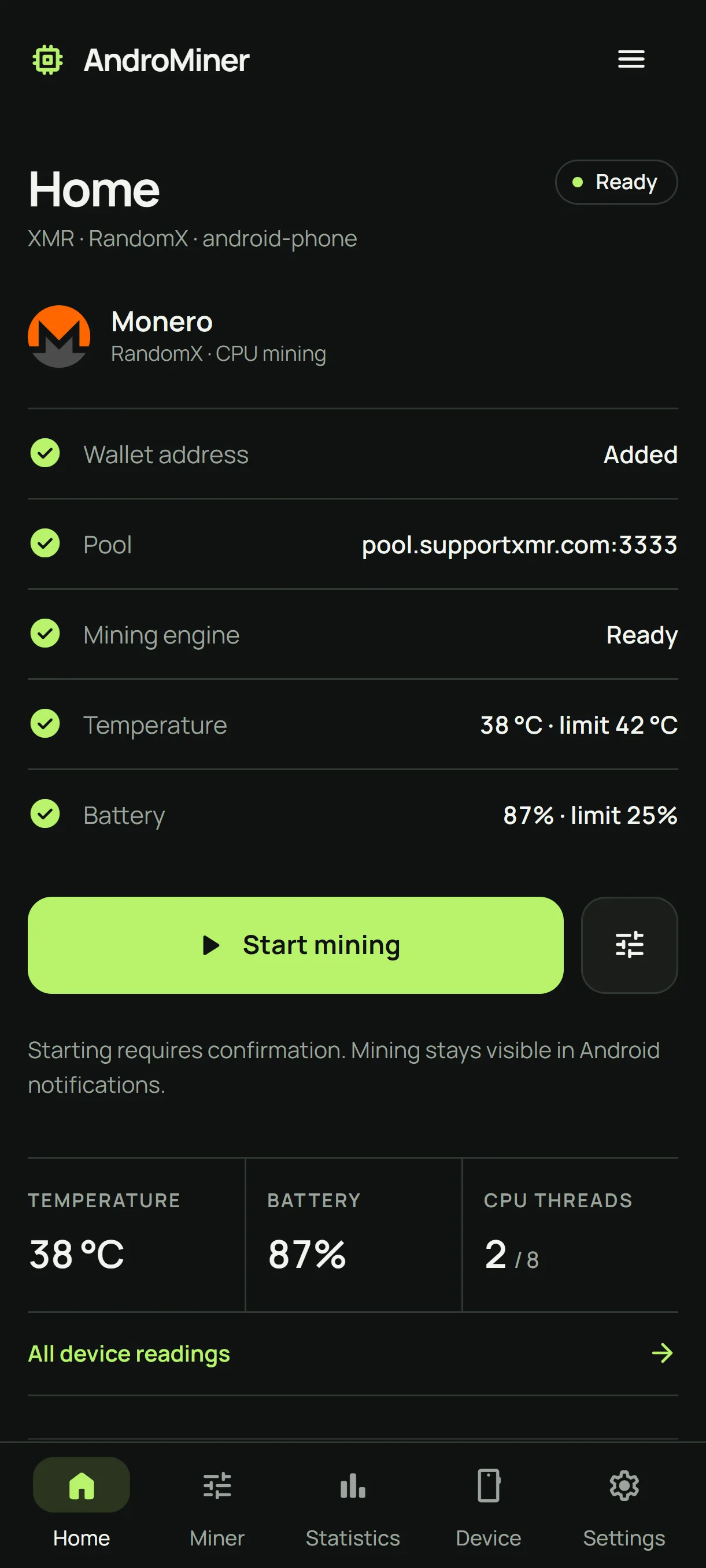
AndroMiner overview with idle mining status and native device readings
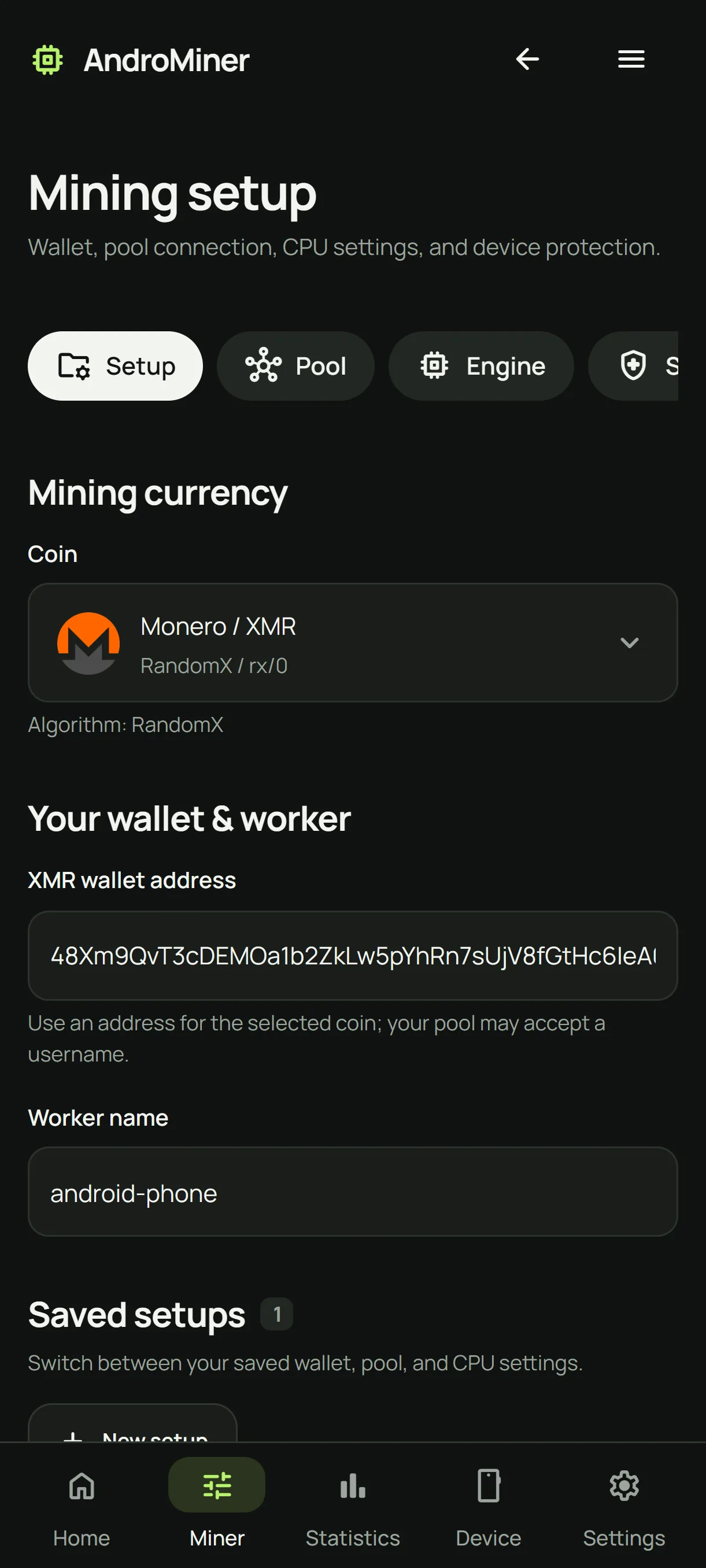
Miner setup with Monero selected and a placeholder wallet

Screens

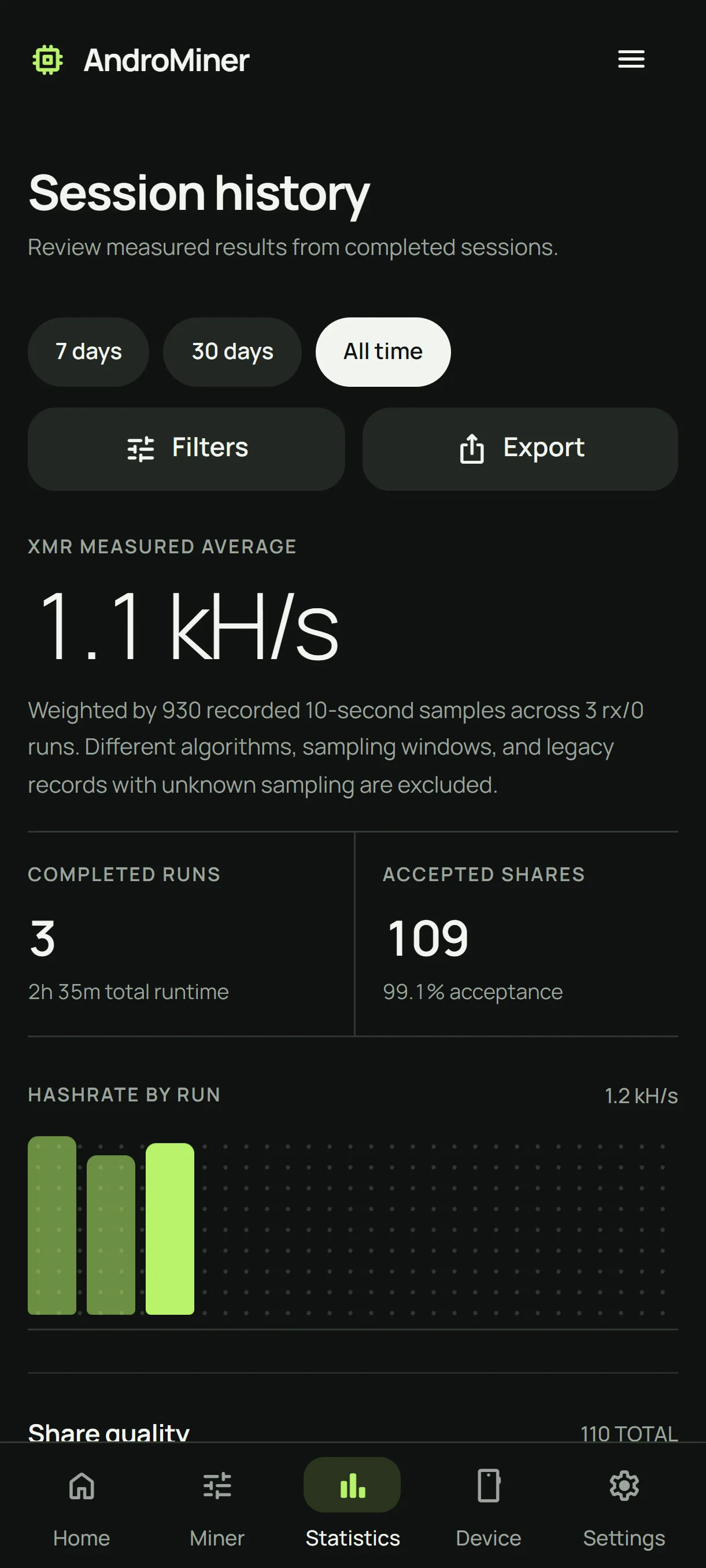
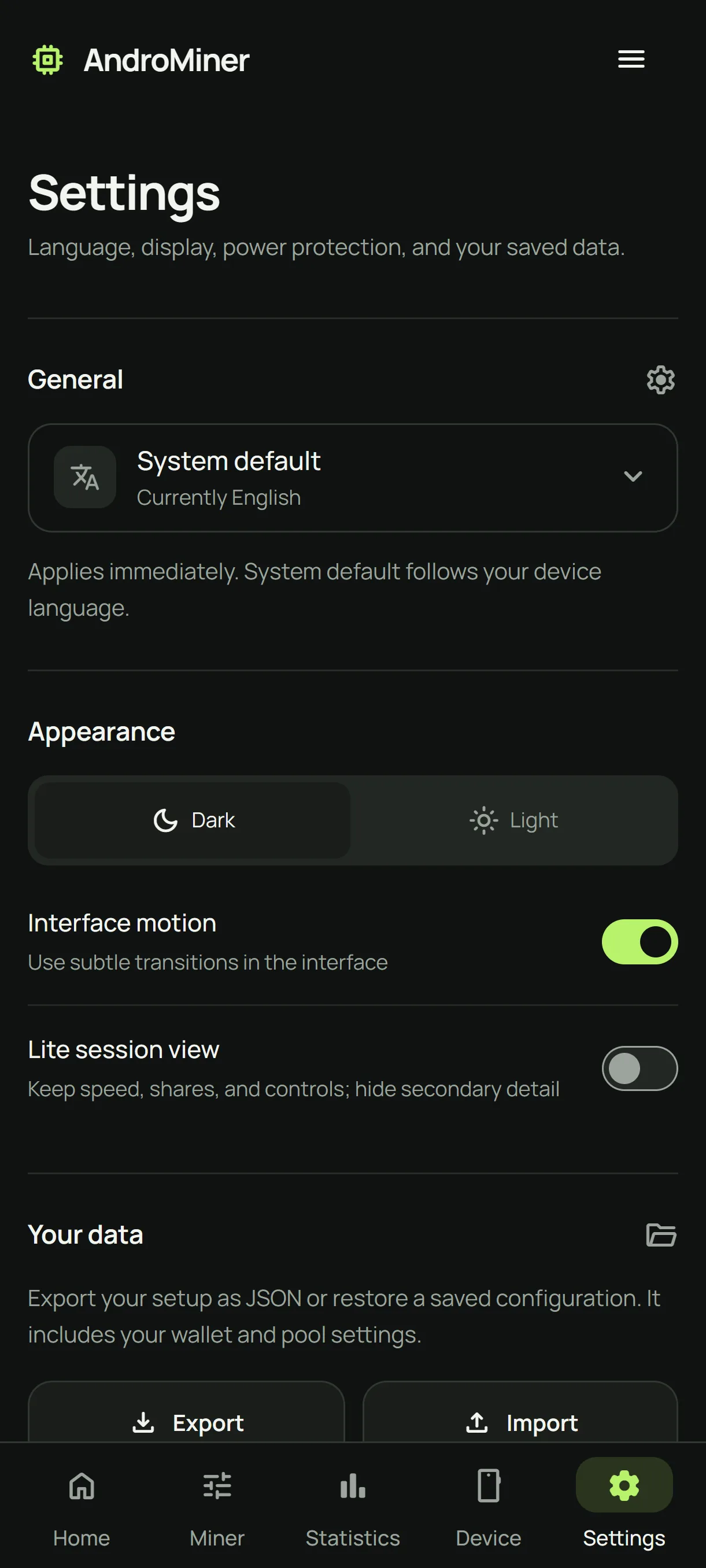
Real Android 16 device screenshots. Mining remained stopped and the wallet is a placeholder.

  • AndroMiner overview with idle mining status and native device readings
    Overview
  • Miner setup with Monero selected and a placeholder wallet
    Miner setup
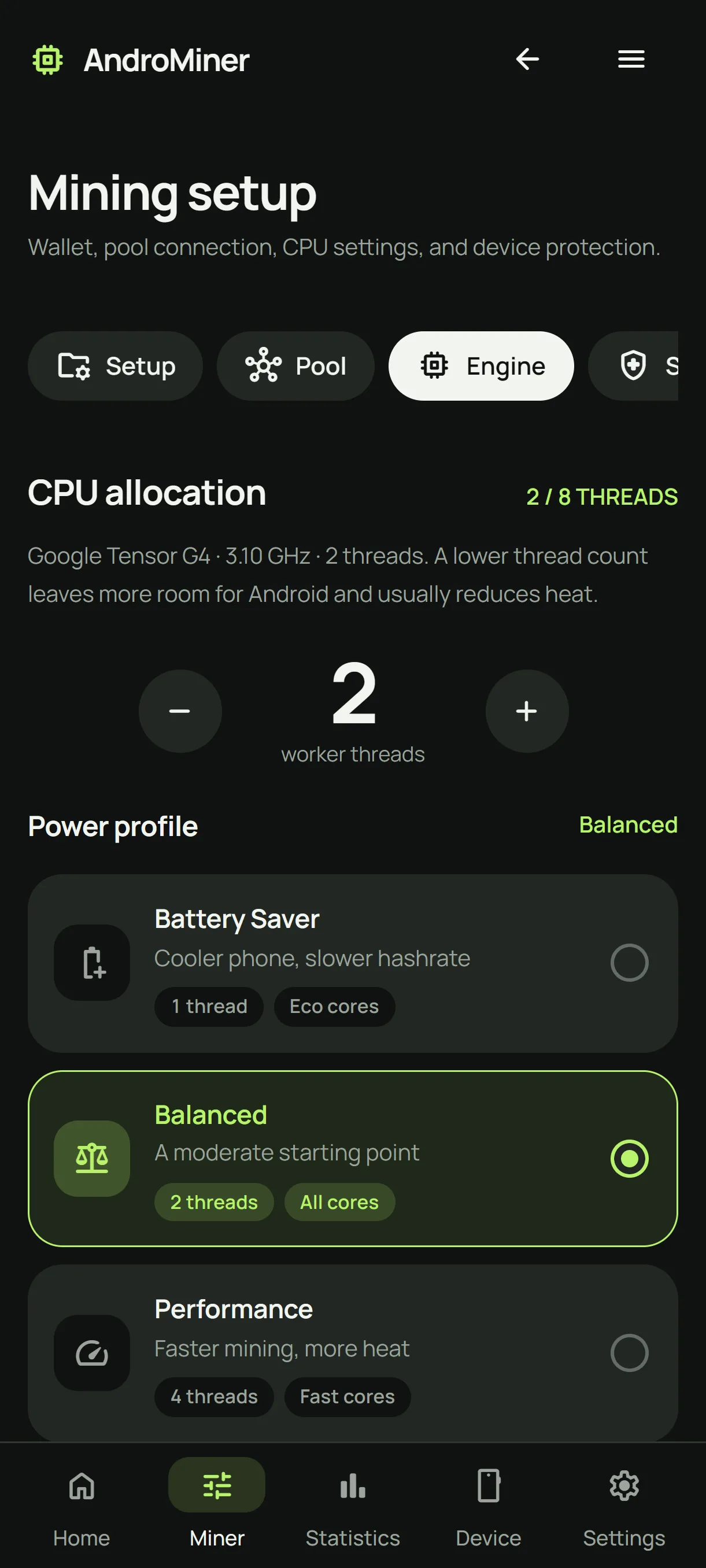
  • Engine settings with CPU thread allocation and power profiles
    Engine
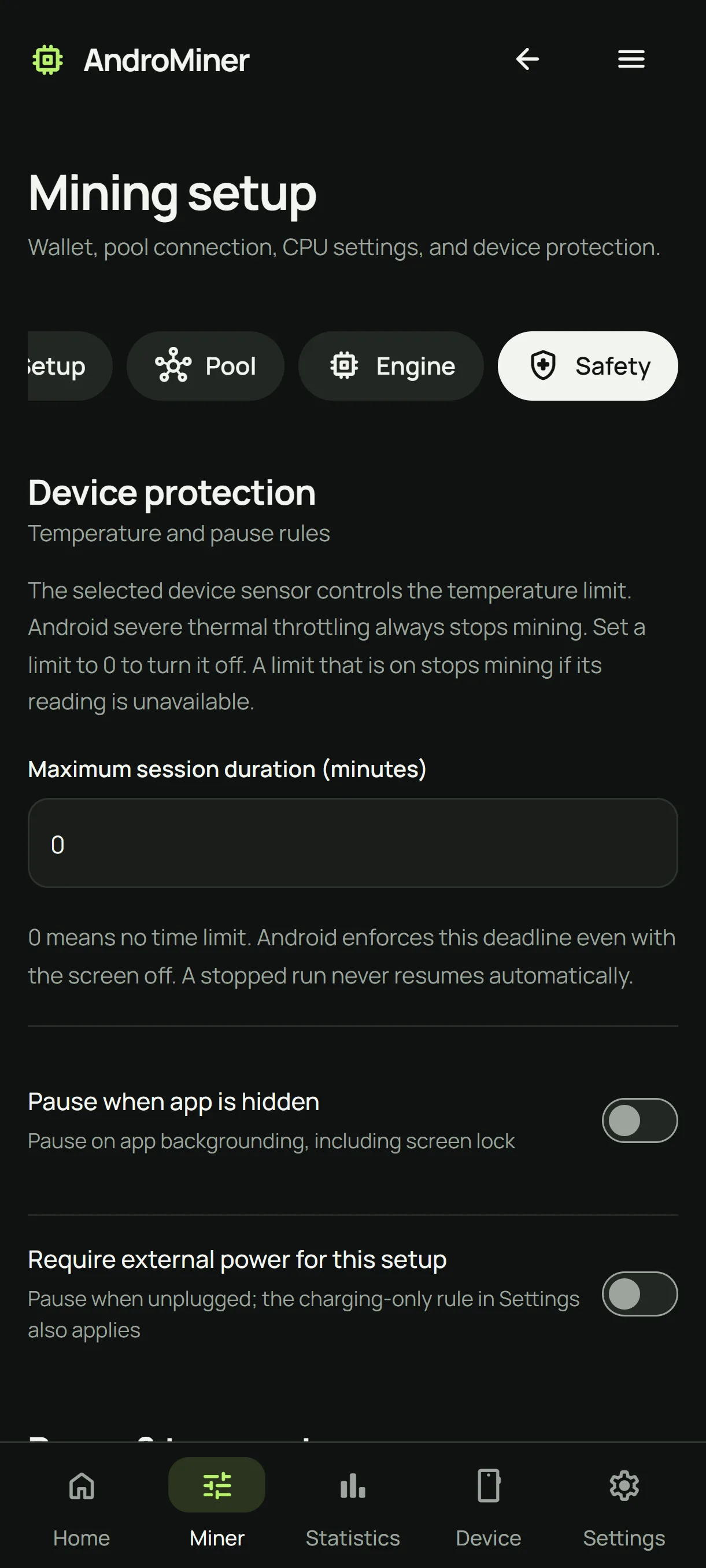
  • Safety settings with temperature and power protection controls
    Safety
  • Session history with completed runs and recorded share results
    History
  • Settings with appearance, configuration export, and update information
    Settings

Features

What AndroMiner does today.

Pools and engines

Configure coins, wallets, workers, and pool connections, then pick an engine.

  • XMRig is supported; XMRigCC and XLArig are experimental
  • Stratum over TCP or TLS, daemon RPC, and NiceHash
  • Test pool DNS, TCP, and TLS reachability without sending a wallet or password

CPU control

Choose a CPU profile or tune the miner yourself.

  • Threads, priority, and core affinity
  • Measured hashrate, accepted and rejected shares, and miner output
  • An offline RandomX benchmark on the Device tab

Sessions and history

Every run is saved on the phone.

  • Native session deadlines, from 1 to 1440 minutes
  • Interrupted runs are recovered and protection stop reasons kept
  • Filtered history and a JSON results export that excludes pool identifiers by default

The app itself

Built to be used daily on a phone.

  • Ten languages, or follow the device language
  • Light and dark mode, with swipe navigation between pages
  • Import and export configuration

Architecture

From the interface you touch down to the process that does the work.

  1. Interface

    Vue 3 and TypeScript, built with Vite. The browser preview cannot mine.

    Capacitor plugin calls, such as NativeMiner.info()

  2. Bridge

    Capacitor 8 connects the interface to the native mining and device APIs. The UI reads the engine registry through NativeMiner.info().

  3. Native service

    MiningGuardService runs as a foreground service with an ongoing notification and a Stop control. It enforces protection without depending on the WebView.

    Launches the engine as a separate process; throttles it with SIGSTOP / SIGCONT

  4. Engine process

    Each engine has its own library (libxmrig.so, libxmrigcc.so, libxlarig.so). All three share XMRig's command line, output format, and HTTP API, so one runtime drives them.

Vue 3
Interface, written in TypeScript and built with Vite
Capacitor 8
Bridge from the web interface to native Android APIs
Android (Java)
Foreground service, protection engine, and miner process control
XMRig 6.26.0
Mining engine, launched as a separate process (libxmrig.so)
arm64-v8a
Required ABI for mining; engines are also built for armeabi-v7a

Device protection

A native foreground service checks the device every 2 seconds while mining. Escalation is immediate; recovery steps back one state at a time.

  1. Normal

    100%

    Nothing below applies.

  2. Caution

    75%

    Battery temperature within 4 °C of your limit, Android thermal status Light, or CPU sensor at 75 °C.

  3. Throttled

    40%

    Within 2 °C of your limit, thermal status Moderate, CPU sensor at 85 °C, or a required sensor missing.

  4. Critical

    Stopped

    Battery temperature at your limit, thermal status Severe or worse, battery at your stop level, or CPU sensor at 95 °C.

Below 100%, the service pauses and resumes the miner in one-second cycles. The policy is covered by unit tests; duty-cycle enforcement and sensor availability depend on the phone and haven't been verified on hardware. Limits reduce risk; they are not guarantees.

Build from source

Install Android Studio, Android SDK platform 36, and JDK 21. Build the miner first with the miner-builder (Android NDK, Git, CMake, Ninja; TLS builds also need make and Perl), then package the APK.

Technical documentation

  1. 1

    Frontend

    bun install --frozen-lockfile && npm run build
  2. 2

    Miner engine

    WITH_TLS=ON miner-builder/build-all-engines.sh
  3. 3

    Debug APK

    npm run android:sync && ./android/gradlew -p android assembleDebug -PbundleMiner=true -PminerVariant=tls

Releases

Release notes for every version. Downloads and checksums are on GitHub.

  1. v1.5.0-beta.1Latest
  2. v1.4.0
  3. v1.3.0
  4. v1.2.0
  5. v1.1.0
  6. v1.0

License

AndroMiner application code

MIT

AndroMiner's application code is licensed under MIT. The mining engines it launches are separate programs under their own licenses; they run as separate processes and are not linked into the app.

Read the license

Third-party components

Licensed by their own authors, separately from AndroMiner.

ComponentVersionLicenseSource
XMRig6.26.0GPL-3.0xmrig/xmrig
XMRigCC3.4.9GPL-3.0Bendr0id/xmrigCC
XLArig5.2.4GPL-3.0scala-network/XLArig
libuv1.48.0MITlibuv/libuv
OpenSSL (TLS builds)4.0.0Apache-2.0openssl/openssl
Third-party notices

Good to know

Safety and limits

  • Mining keeps the CPU under sustained load. It can overheat a phone, degrade the battery, and reduce responsiveness. Prefer a spare device and supervise every run.
  • Sensor support varies by phone. Missing required temperature or battery readings block mining or stop an active run.
  • XMRigCC and XLArig are experimental. They are built and checked as binaries but have not been run on a device.
  • The app does not calculate earnings or pool payouts.

Availability

Android (ARM64)
Released

Contributing

Translations are welcome. Report problems with your device model, Android version, APK variant, and steps to reproduce, with wallet addresses and pool credentials removed. For code changes, describe the behavior changed and how you checked it on Android.